

In the intricate tapestry of modern civilization, few threads are as vital and as vulnerable as the global food grid. For decades, the complexity of this network has been a marvel of efficiency, capable of delivering avocados to Scandinavia and Ukrainian grain to North Africa. Yet, as recent global events have starkly demonstrated, this very complexity is also its Achilles’ heel. Geopolitical tensions, extreme weather events, and logistical bottlenecks have exposed the fragility of traditional, convoluted supply chains. The consequence? Price volatility, localized food shortages, and a growing erosion of trust.
It is time for a paradigm shift. It is time to move beyond opaque, multi-tiered networks and embrace a new model of direct connectivity. The future of global food security isn’t just about producing more; it’s about connecting smarter.
The Problem: Opaque Chains and Fragile Links
Traditional global food supply chains are often characterized by a lack of visibility. From the farmer who plants the seed to the consumer who eats the final product, the journey is frequently obscure, passing through numerous intermediaries, storage facilities, and processing hubs. This opacity breeds inefficiency and risk.
- Information Disconnect: When multiple stakeholders operate in silos, critical data about crop yields, quality issues, or transportation delays can fail to flow smoothly, leading to misaligned supply and demand.
- Vulnerability to Disruption: If a critical processing hub or a key transit route is compromised, the entire chain can grind to a halt. There is often a lack of agility to quickly reroute or adjust.
- Erosion of Trust: Consumers are increasingly demanding to know where their food comes from and how it was produced. When the origin story is lost in a black box of logistics, building that trust is impossible.
The Solution: A Neural Network for Global Agriculture
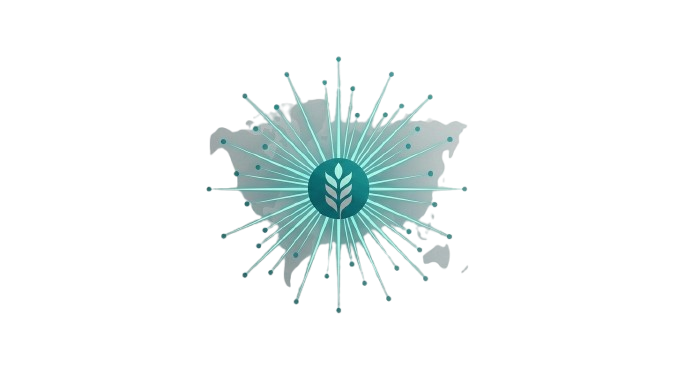
The answer is not a retreat into isolationism, but a forward-thinking reimagining of how we connect. The provided visual is a powerful metaphor for this new approach. It depicts a central point perhaps a sophisticated, technology-driven sourcing platform as the robust ‘neural hub’ (the grain node). Radiating outward from this hub are direct, clear lines of connectivity to countless ‘distribution nodes’ (the outer dots). The background watermark of the world map confirms this isn’t just a local initiative; it’s a globally scalable solution.
This visual represents a fundamental shift:
- Transparency by Design: In a connected, data-driven network, every point is visible and accountable. The path from the central grain node to each distribution node is clear, documented, and traceable.
- Resilience through Decentralization: By utilizing a web of direct connections, the network is fundamentally more robust. If one pathway is obstructed, others are readily available to maintain the flow. The system is resilient, not fragile.
- Real-Time Data Integration: The teal lines connecting the nodes symbolize more than just physical routes; they represent the flow of real-time information. Technology, from IoT sensors on farms to blockchain-based traceability platforms, activates these connections, providing instantaneous insights.
Why Direct Connectivity is Essential Now
In the context of current global challenges, the transition to a directly connected, transparent food grid has moved from a desirable innovation to a strategic imperative.
- Combating Global Food Insecurity: Direct, efficient pathways reduce waste, lower transaction costs, and allow food to move rapidly to where it is needed most, particularly vital when specific regions face production shocks.
- Enhancing Trust and Traceability: Consumers, regulators, and environmental advocates are scrutinizing the food supply chain like never before. Direct connectivity provides the verifiable proof of provenance needed to meet demands for sustainability, fair labor practices, and quality assurance.
- Optimizing Resource Efficiency: Clearer data and more direct routes minimize unnecessary transportation, optimize storage, and reduce the environmental footprint of the entire grid.
Beyond Efficiency: Building Partnerships and Resilience
Redefining the global food grid through direct connectivity is about more than just moving molecules from A to B efficiently. It’s about establishing direct, symbiotic relationships between producers, processors, and distributors.
When a sourcing hub connects directly with a farmer’s cooperative in a specific region (visualized by the direct lines to the distinct outer dots), both parties benefit. The farmer gains predictable access to a global market and receives more timely payment. The hub secures a reliable, documented supply of specific ingredients.
This approach creates a resilient ecosystem, not just a robust chain. The multiple radiating lines on the map remind us that our strength lies in a diversified, connected global network, ensuring that the critical central grain node can continue to nourish the grid, regardless of localized challenges. The future of global food is connected, transparent, and resilient—and direct connectivity is the path to achieving it.